“Όχι” λένε οι κάτοικοι της Καβάλας, της Θάσου αλλά και των γύρων περιοχών ενάντια στην αποθήκευση βιομηχανικών ρύπων CΟ2 στο υπέδαφος του Πρίνου, ένα “πράσινο” project το οποίο θα χρηματοδοτηθεί από το Ταμείο Ανάκαμψης και την ΕΕ.
Τα ερωτήματα πολλά και τα θέτουν οι ίδιοι οι πολίτες.
Τί αναφέρουν Energean και η θυγατρική EnEarth
Η κλιματική αλλαγή, το net zero, η συμβολή στο περιβάλλον και η διατήρηση χιλιάδων θέσεων εργασίας (;;;) αποτελούν τις βασικές αναφορές στις ιστοσελίδες των εταιρειών Energean-Eneath για την αποθήκευση του διοξειδίου του άνθρακα στον Πρίνο.
Στην επίσημη ιστοσελίδα της Energean αναφέρονται, μεταξύ άλλων, τα ακόλουθα:
“Το project αποθήκευσης CO2 στον Πρίνο πηγαίνει πιο πέρα από το να στηρίζει την στρατηγική της Energean για το net zero, την επίτευξη μηδενικού ισοζυγίου αερίων του θερμοκηπίου…Ο σκοπός του project αποθήκευσης CO2 στον Πρίνο (Prinos CO2 Storage) είναι να συνεισφέρει στην τοπική και περιφερειακή απανθρακοποίηση με την αποθήκευση CO2 που θα δεσμεύεται από βιομηχανίες που δεν είναι δυνατό να αποφύγουν την εκπομπή του (hard to abate industries), από την χρήση τεχνολογιών άμεσης σύλληψης CO2 στον αέρα, από βιοενέργεια, από την ναυτιλιακή βιομηχανία και άλλες πηγές.
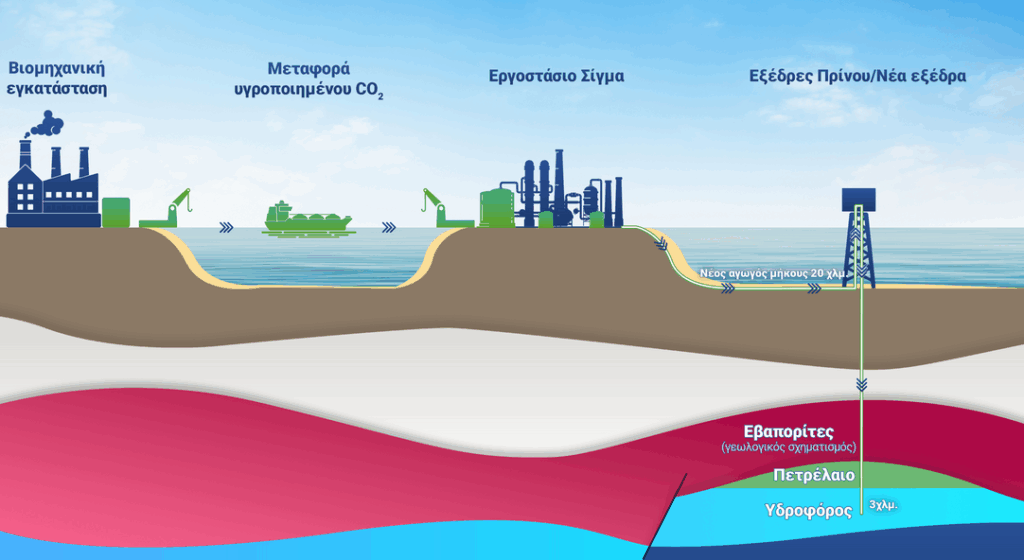
Φορέας του project, πλέον, η EnEarth, εταιρεία του ομίλου Energean, η οποία θα δραστηριοποιηθεί στην αποθήκευση και μεταφορά CO2 καθώς και στην απευθείας δέσμευση CO2 από την ατμόσφαιρα. Τον Ιούνιο του 2024, η EnEarth κατέθεσε αίτηση για την απόκτηση Άδειας Αποθήκευσης CO2 στον Πρίνο.
Το project αποτελεί καθοριστικής σημασίας μέρος του Στρατηγικού Σχεδίου για την Δέσμευση και Αποθήκευση Άνθρακα στη Μεσόγειο (Mediterranean CCS Strategic Plan) το οποίο έχει αναπτυχθεί από την Γαλλία, την Ιταλία και την Ελλάδα, με στόχο να δημιουργηθεί ο πρώτος βιομηχανικός/ εμπορικός αποθηκευτικός κόμβος CO2 στη ΝΑ. Μεσόγειο”.
Στην ιστοσελίδα της EnEarth αντιστοίχως αναφέρεται ότι “Στην EnEarth, το όραμά μας είναι να βοηθήσουμε τη βαριά βιομηχανία να επιτύχει τους στόχους της για μηδενικό ισοζύγιο (net zero) σε εκπομπές αερίων του θερμοκηπίου ώστε, παράλληλα με τη συμβολή στο περιβάλλον, τα εργοστάσια να παραμείνουν σε λειτουργία, διατηρώντας χιλιάδες θέσεις εργασίας στις τοπικές κοινωνίες”.
Γιατί αντιδρούν οι πολίτες
Το τελευταίο διάστημα έχουν πραγματοποιηθεί πολλές δράσεις πολιτών και περιβαντολογικών οργανώσεων οι οποίοι κρούουν τον κώδωνα του κινδύνου.
Για το συγκεκριμένο project, οι πολίτες καταγγέλλουν ότι υπάρχει ελλιπής έως μηδενική ενημέρωση για την ύπαρξη ή μη πιθανών κινδύνων, όπως επίσης και των επιπτώσεων στο περιβάλλον, στις επόμενες γενεές αλλά και στην οικονομία της περιοχής, καθώς έχει άμεση σχέση και με την αλιεία και τον τουρισμό σε Καβάλα και Θάσο.
Παράλληλα τίθεται και ένα άλλο ερώτημα: η υποτιθέμενη πράσινη αποθήκη στον Πρίνο θα αποθηκεύει ελληνικό διοξείδιο του άνθρακα ή θα αποτελέσει τη χωματερή της Ευρώπης;
Η “Πρωτοβουλία ενάντια στην αποθήκευση CO2 στον Πρίνο” σε σχετική ανάρτηση στο Facebook αναφέρει ότι “Λένε ψέματα ότι το έργο θα εξυπηρετήσει ααποκλειστικάελληνικά συμφέροντα.
Γνωρίζουμε πολύ καλά ότι το έργο επί της ουσίας επιβάλλεται στη χώρα (για αυτό και η αδρή χρηματοδότηση από την ΕΕ) για την εξυπηρέτηση ευρωπαϊκών πολυεθνικών συμφερόντων. Η προσπάθεια να πλασαριστεί ως έργο “ελληνικό” είναι το χρυσωμα του χαπιού που πρέπει να καταπιεί αμασητο η τοπική κοινωνία, προκειμένου να δεχτεί βίαιη αλλαγή του χαρακτήρα του τόπου”.
Στις 26 Μαϊου 2025 η Περιφερειακή Αρχή φέρνει για συζήτηση στην Επιτροπή Περιβάλλοντος, την Μελέτη Περιβαλλοντικών Επιπτώσεων (ΜΠΕ) για τη μονάδα αποθήκευσης CO₂ στον Πρίνο.
Οι πολίτες της Θάσου και της Καβάλας ζητούν απευθείας μετάδοση της συνεδρίασης για πλήρη διαφάνεια, καθώς και ειδική συνεδρίαση αποκλειστικά για το θέμα, με παρουσία των κατοίκων της Θάσου και ανεξάρτητων επιστημόνων.
Είναι 100% ασφαλής η αποθήκευση του CO2 στο έδαφος;
Σε σχετικό άρθρο του 2023, των Mia DiFelice και Oakley Shelton-Thomas στο Food & Water Organization, για την υποτιθέμενη “πράσινη” και ασφαλής αποθήκευση του διοξειδίου του άνθρακος στο υπέδαφος αναφέρονται τα ακόλουθα:
Ο Άνθρακας Πιθανότατα Δεν Θα Παραμείνει στο Έδαφος
Η υπόσχεση της δέσμευσης και αποθήκευσης άνθρακα είναι ότι θα πρέπει να κρατάει μόνιμα το CO2 έξω από την ατμόσφαιρα και να αποτρέπει περαιτέρω την κλιματική αλλαγή. Αλλά η μονιμότητα κάθε άλλο παρά εγγυημένη είναι.
Πέρα από τους σεισμούς, η αποθήκευση άνθρακα είναι πολύ απρόβλεπτη. Η εκτόξευση CO2 στο υπέδαφος δημιουργεί μεγάλη πίεση. Μπορεί επίσης να προκαλέσει χημικές αντιδράσεις με τα ορυκτά στο υπέδαφος. Ως αποτέλεσμα, πολλές τοποθεσίες αποθήκευσης έχουν δει τη γύρω γεωλογία να κάνει πράγματα που οι επιστήμονες δεν περίμεναν ποτέ, θέτοντας σε κίνδυνο τα έργα.
Δεν έχουμε τα εργαλεία για να προβλέψουμε τι θα συμβεί στα πηγάδια με την πάροδο του χρόνου – ή ακόμα και για να διασφαλίσουμε ότι ο άνθρακας παραμένει στη θέση του. Η τεχνολογία απεικόνισης CO2 μόλις τώρα ξεκινά.
Και αυτό απλώς καλύπτει τα πηγάδια. Πρέπει επίσης να ανησυχούμε για διαρροές στους αγωγούς που μεταφέρουν το CO2 από το σημείο όπου αρχικά δεσμεύεται στα σημεία έγχυσης και γύρω από τα ίδια τα σημεία έγχυσης.
Η πίεση που δημιουργείται από την έγχυση και μόνο μπορεί να οδηγήσει σε ρωγμές, παραμορφώσεις στο πολύ σημαντικό στρώμα στεγανοποίησης ή χημικές αντιδράσεις που καθιστούν το στρώμα στεγανοποίησης διαρρεύσιμο.
Δεδομένου ότι πολλές τοποθεσίες αποθήκευσης άνθρακα βρίσκονται μέσα ή γύρω από παλιά πηγάδια πετρελαίου και φυσικού αερίου, αυτά τα πηγάδια δημιουργούν κάθε είδους κινδύνους για διαρροές. Οποιοδήποτε παλιό, ασφράγιστο ή κακώς σφραγισμένο πηγάδι είναι ουσιαστικά ένας αγωγός προς την επιφάνεια. Ακόμα χειρότερα, οι ερευνητές έχουν διαπιστώσει ότι το CO2 μπορεί να διαφύγει αργά κατά μήκος της επένδυσης των πηγαδιών και να διαβρώσει τα περιβλήματα και τις σφραγίδες των πηγαδιών.
Carbon Probably Won’t Stay in the Ground
The promise of carbon capture and storage is that it should permanently keep CO2 out of the atmosphere and prevent more climate change. But permanence is far from guaranteed.
Earthquakes aside, carbon storage is very unpredictable. Shoving CO2 underground creates a lot of pressure. It can also cause chemical reactions with the minerals underground. As a result, many storage sites have seen the surrounding geology do things scientists were never expecting, jeopardizing the projects.
We don’t have the tools to predict what will happen to wells over time — or even to ensure that the carbon is staying put. CO2 imaging technology is just getting off the ground.
And that’s just covering the wells. We also have to worry about leaks in the pipelines transporting CO2 from where it’s first captured to the injection sites and around the injection sites themselves.
The pressure created by injection alone can lead to fractures, deformations in the all-important sealing layer, or chemical reactions that make the sealing layer leaky.
Since many carbon storage sites are in or around old oil and gas wells, these wells create all sorts of risks for leaks. Any old, unsealed, or poorly sealed well is essentially a pipeline to the surface. Even worse, researchers have found that CO2 can slowly escape along well-lining and corrode well casings and seals.
Κίνδυνοι Αποθήκευσης Άνθρακα – Καταστροφικά Ατυχήματα
Εκτός από τους κινδύνους βραδύτερων ή μικρότερων διαρροών, η αποθήκευση άνθρακα διακινδυνεύει επίσης τεράστιες απελευθερώσεις CO2 σε εκρήξεις ή κατά την έγχυση.
Αυτές οι διαρροές μπορεί να είναι θανατηφόρες, καθώς το συμπιεσμένο CO2 μπορεί να προκαλέσει ασφυξία στους ανθρώπους. Το 1986, μια λίμνη στο Καμερούν απελευθέρωσε μια τεράστια φυσαλίδα CO2 που σχηματίστηκε από ηφαιστειακή δραστηριότητα. Αυτό το CO2 εξαπλώθηκε σε ένα σύννεφο που σκότωσε σχεδόν 1.800 ανθρώπους, μερικούς σε απόσταση μεγαλύτερη των 15 μιλίων. Μια διαρροή αγωγού στη Σατάρτια του Μισισιπή νοσηλεύτηκε σχεδόν 50 κατοίκους το 2020.
Επιπλέον, το δεσμευμένο CO2 συχνά δεν είναι μόνο CO2. Μπορεί να έχει επικίνδυνες ακαθαρσίες, συμπεριλαμβανομένων πτητικών οργανικών ενώσεων (VOC) και υδραργύρου. Αυτά δεν είναι μόνο άσχημα νέα για τη δημόσια υγεία σε περίπτωση ρήξης — αυτές οι ακαθαρσίες είναι επίσης διαβρωτικές, αυξάνοντας τις πιθανότητες διαρροής εξαρχής. (Για να μην αναφέρουμε ότι η αφαίρεσή τους προσθέτει στο ήδη τεράστιο ενεργειακό κόστος της δέσμευσης άνθρακα.)
Οι ενισχυτές θα σας έλεγαν ότι όλα αυτά είναι προβλήματα που μπορούν να λυθούν — «Απλώς δείτε πόσο μακριά έχουμε φτάσει με τις διαρροές μεθανίου!»
Εκτός από το ότι στην πραγματικότητα δεν έχουν φτάσει μακριά. Η παραγωγή φυσικού αερίου εξακολουθεί να διαρρέει ανησυχητικές ποσότητες μεθανίου. Και δεν έχουμε βελτιώσει πολύ ούτε στο μέτωπο της αποθήκευσης — απλώς κοιτάξτε την έκρηξη στο Aliso Canyon, η οποία έριξε παράλογες ποσότητες μεθανίου από την εγκατάσταση αποθήκευσης για μήνες το 2016.
Carbon Storage Risks Catastrophic Accidents
On top of the risks of slower or smaller leaks, carbon storage also risks huge releases of CO2 in blowouts or during injection.
These leaks can be deadly, as compressed CO2 can suffocate people.In 1986, a lake in Cameroon released a massive bubble of CO2 that formed from volcanic activity. That CO2 spread in a cloud that killed nearly 1,800 people, some more than 15 miles away. A pipeline leak in Satartia, Mississippi, hospitalized almost 50 residents in 2020.
Additionally, captured CO2 often isn’t just CO2. It can have dangerous impurities, including volatile organic compounds (VOCs) and mercury. That’s not just bad news for public health in case of a rupture — these impurities are also corrosive, increasing the odds of a leak in the first place. (Not to mention, removing them adds to carbon capture’s already massive energy costs.)
Boosters would tell you that these are all problems that can be solved — “Just look at how far we’ve come with methane leaks!”
Except they haven’t actually come far. Producing natural gas still leaks disturbing amounts of methane.And we haven’t improved much on the storage front, either — just look to the Aliso Canyon blowout, which spewed unconscionable amounts of methane from the storage facility for months in 2016.
Η αποθήκευση του άνθρακα δεν διορθώνει το κλίμα
Η αποθήκευση άνθρακα είναι γεμάτη επιπλοκές και κινδύνους που απειλούν τη δημόσια υγεία και ασφάλεια. Επίσης, δεν μπορεί να τηρήσει την βασική της υπόσχεση: να αποθηκεύει μόνιμα τη ρύπανση από άνθρακα και να επιβραδύνει την κλιματική αλλαγή.
Γιατί λοιπόν να ξοδεύουμε δισεκατομμύρια δολάρια για να κάνουμε επικίνδυνες γεωτρήσεις, να μεταφέρουμε επικίνδυνο CO2 σε μεγάλες αποστάσεις και να παρακολουθούμε για αναπόφευκτες διαρροές CO2; Επειδή έτσι το θέλουν οι μεγάλες πετρελαϊκές εταιρείες.
Η δέσμευση άνθρακα επιτρέπει στις εταιρείες πετρελαίου και φυσικού αερίου να συνεχίσουν να επωφελούνται από τις ρυπογόνες δραστηριότητές τους, με ένα νέο, ψεύτικο «πράσινο» σήμα και μια επιπλέον βοήθεια από δημόσιους πόρους.
Όλα αυτά είναι απλώς μια ύποπτη απόσπαση της προσοχής από τις πραγματικές λύσεις που χρειαζόμαστε για να αλλάξουμε την κατάσταση στην κλιματική αλλαγή. Αντί να επενδύουμε στη δέσμευση και αποθήκευση άνθρακα, η κυβέρνησή μας πρέπει να υποστηρίζει — και μόνο να υποστηρίζει — τις ανανεώσιμες πηγές ενέργειας, την αποθήκευση μπαταριών και την ενεργειακή απόδοση.
Carbon Storage Is Not a Climate Fix
Carbon storage is riddled with complications and dangers that threaten public health and safety. It also can’t keep its core promise: to permanently store carbon pollution and slow down climate change.
So why would we spend billions of dollars to drill risky wells, move dangerous CO2 long distances, and monitor for inevitable CO2 leaks? Because Big Oil wants it that way.
Carbon capture allows oil and gas companies to continue profiting off their polluting operations, with a new, bogus “green” badge and an extra helping of public resources.
This is all just a dodgy distraction from the real solutions we need to turn the tide on climate change. Instead of investing in carbon capture and storage, our government needs to be supporting — and only supporting — renewable energy, battery storage, and energy efficiency.
Greenpeace: The Great Carbon Scam
Σε άρθρο του Rex Weyler για την Greenpeace, που φέρει τον τίτλο “The Great Carbon Capture Scam” δηλώνονται τα ακόλουθα:
We know that oil companies hid knowledge of global heating for decades, but the captains of petroleum also schemed to turn the ecological crisis into a profit centre. The industry devised a plan to swindle money from the public purse by pretending to address the climate issue while using subsidies to increase oil production. If one had no moral compass, one might say their scam was a stroke of genius.
Since the oil industry — Shell, Chevron, and others — were not prepared to actually slow oil production to halt global heating, and since they had no intention of aiming for zero carbon emissions, they invented “net zero.” The “net” requires that we subtract some carbon from total emissions to create the illusion of “zero” emissions. Thus, the patriarchs of petroleum profiteering came up with “carbon capture,” a deception that has netted them billions of dollars and euros in public money.
Even the Intergovernmental Panel on Climate Change (IPCC) has enabled the scam, since most IPCC climate models require carbon capture and storage (CCS) to balance the carbon books, always of course, at some time in the distant future.
How the scam works
Oil industry geologists knew in the 1950s that all oil fields would deplete over time, as pressure dropped in rock formations and the oil would no longer flow. They developed certain “enhanced oil recovery” technologies to extend the life of depleted oil fields, by fracking and by pumping carbon dioxide (CO2) into old wells. However, these technologies were expensive and reduced their gargantuan profit margins. Furthermore, by 1965, even the American Petroleum Institute had anticipated the “catastrophic consequences” of carbon dioxide emissions. Thus the Great Carbon Capture Scam was born.
Industry insiders publicly claimed that they could capture and store the dangerous CO2, using public money of course, while secretly planning to use this captured CO2 for enhanced oil recovery, which would create more carbon emissions. It might take decades for the public to figure out that they had been filched.
In 1948, Chevron discovered a promising field in Scurry County, Texas, which showed signs of depletion by 1951. In 1972, they began the world’s first CCS project, using waste carbon dioxide from a gas field 400 kilometers away, near the Mexican border, shipping it north through a pipeline, and using the gas to extend the life of their Scurry field. After using the CO2, they vented the gas, so there was no real climate advantage. However, the technology worked to produce more oil.
Since the companies intended to use captured CO2 for enhanced oil recovery, the technology was then called “Carbon Capture, Use, and Storage,” (CCUS). In 1992, international oil companies held the first CCUS conference in the Netherlands.
In 1998 Chevron, Exxon-Mobil, Shell, and the Australian government began promoting carbon capture and use for the huge Gorgon gas field in Australia that had two public relations problems: It was in a nature reserve and it produced a relatively dirty, climate-wrecking gas with 14% carbon dioxide waste. Since the carbon had to be captured anyway, to meet export regulations, the oil companies lobbied to have Australian citizens pay for it.
Chevron and their partners received a $60-million grant from the Australian government, and in 2003 Chevron claimed that CCUS was “a vital technology to ensure a safe, reliable supply of energy to meet the world’s needs.” Meanwhile, an API promotional campaign confirmed that CCS was primarily used to “enhance oil production.”
In Australia, the companies promised to capture millions of tonnes of carbon, beginning in 2016, but for the first four years they captured none, and in 2019 the Gorgon CCUS project clogged up with sand and had to shut down for repairs.
To date, Gorgon has captured about 30% of its target for “processing emissions,” but this term hides the fact that the companies have only captured about 2% of the target for total emissions. However, the one thing that Chevron did capture and store was 100% of the $60 million in public hand-outs. “Managing greenhouse gas emissions,” Chevron declared, “is an integral part of how Chevron plans and executes its business.”
The corporate strategy appears to be: Socialize costs and privatize profits. However, carbon capture added an additional strategy: Socialize risk. Since carbon emissions would accelerate global heating, and since the hydrogen produced is highly explosive, the companies faced severe liability risks. No problem: In Australia, Chevron and Shell convinced the government, the taxpayers, to accept liability for the hazardous Gorgon project.
The swindle appears simple: Pretend to help solve a problem, while making the problem worse, socialize the costs and liabilities, and privatize the profits. Clever. However, the unscrupulous scheme began to show signs of unravelling.
Red herrings and red flags
In 2006, the German Federal Ministry of the Environment determined that there was “no direct cost advantage for technologies using fossil fuels [i.e. carbon capture] … compared to advanced renewable energy technologies,” and a year later, the Australian Environmental Protection Agency recommended that the Gorgon project should not proceed due to environmental risks.
EnergyWashington Week revealed, as reported by Oil Change International and the US Environmental Protection Agency, that “A power plant equipped with a CCS system … would need roughly 10 to 40% more energy than a plant of equivalent output without CCS.” More energy consumption yields more CO2 emissions, not less. These warnings and recommendations were ignored.
The American Petroleum Institute continued to promote carbon capture, although their own consultant report on “Carbon Dioxide Enhanced Oil Recovery” warned that “the amount of infrastructure necessary to perform geologic storage on a meaningful level is equivalent to the existing worldwide infrastructure associated with current oil and gas production.” To reverse global heating, CCUS would require doubling the world’s petroleum infrastructure, built up over the previous century, a near impossibility with costs running into the trillions. Furthermore, that infrastructure would require massive mining, transport of materials, cement, steel, and carbon-intensive fabrication, yielding more emissions.
In 2007, as these nagging problems surfaced, BP scrapped a £500-million carbon capture scheme in Scotland. In the US, a “clean coal” CCS project in Mississippi, behind schedule and billions over budget, closed, and the Petra Nova CCS plant in Texas—promising to capture 1.6 million tonnes of CO2 annually—missed its targets over three years of operation and shut down in 2020. The Carbon Capture and Sequestration Technologies program at MIT closed due to the technology’s ecological damage and unviable economics in 2016. By the end of 2020, more than 80% of US CCUS projects had failed.
Meanwhile, Western Australia’s Environmental Protection Authority concluded in 2019 that Chevron should be held accountable for venting gas from the Gorgon project and for failing to capture and store the project’s emissions as promised and required.
Quest for dollars
According to a January 2022 study by Global Witness, Shell’s Quest plant in Canada’s tar sands, is emitting more carbon than it is capturing, with the same annual carbon footprint as 1.2 million gas-powered vehicles. Shell’s scheme, one of the biggest boondoggles of carbon capture chicanery, uses the hydrogen produced to refine thick, toxic bitumen into synthetic crude, creating more carbon emissions. The project also emits methane, a much more potent greenhouse gas.
Global Witness found that although Shell’s Quest plant was capturing 4.81-million tonnes of carbon annually (Mt/yr), it was emitting 12.47 Mt/yr in greenhouse gases from on-site and supply chain emissions and from the power required to operate the CCS system. The plant therefore annually is responsible for some 7.66-million tonnes of greenhouse gases, even after the CCUS bookkeeping tricks.
Shell originally promised to capture 90% of emissions, had to admit failure, and changed their target to 65%, but according to the Institute for Energy Economics and Financial Analysis, the Quest plant failed to reach its target every year from 2015 to 2020.
Upon awarding the Quest project a Canadian-dollar $834-million subsidy (US$654-million, €571-million) Canada’s Ministry of Natural Resources Joanna Sivasankaran claimed that CCS was “an important tool on the pathway to reaching Canada’s ambitious climate goals,” to reach “net-zero by 2050.” However, since the Quest project emits more than it captures and increases tar sands production, the dirtiest, most carbon-intensive petroleum product on Earth, these “ambitious climate goals,” remain unattainable and appear preposterous.
Four hundred international scientists, academics, and energy analysts signed a letter to the Canadian government asking that they halt the subsidy scam. “Deploying CCUS at any climate-relevant scale,” they wrote, “carried out within the short timeframe we have to avert climate catastrophe without posing substantial risks to communities on the front lines of the buildout, is a pipe dream.”
The letter warned that CCUS is “not a negative emissions technology,” with billions of taxpayer dollars used to boost oil production. The scientists and scholars warned of the health impacts to local communities, that the tax subsidies would tie Canada to “dependence on dirty tar sands,” and that the project would add some 50 million metric tons CO2 emissions annually by 2035.
According to Lubicon Cree citizen Melina Laboucan-Massimo, the tar sands project yields “elevated rates of cancers, as well as elevated rates of respiratory illnesses … contamination to the water, destruction and complete fragmentation of the Boreal forest.”
According to Reuters, 26 commercial CCS facilities around the world capture about 40 million tonnes of CO2 each year. To put that in perspective, the world emits about 36.4-billion tonnes of CO2 each year.
That means that after 50 years of CCS development; after billions of dollars in subsidies; after all the hype, deceits, tax breaks, and guarantees; the oil industry captures about 0.1% of annual CO2 emissions. The other 99.9 % pollutes the atmosphere and heats Earth. Meanwhile, most of this captured CO2 is used to produce more oil. Since that first CCS project began in 1972, world CO2 emissions have almost tripled from 14.68 to 36.4 billion tonnes per year, not exactly the “net zero” we were promised.
Carbon capture was a scam from the beginning, and remains so today.
Resources and links:
Carbon Capture: Five Decades of False Hope, Hype, and Hot Air,” Andy Rowell and Lorne Stockman, Oil Change International, June 2021.
Shell’s fossil hydrogen plant in Canada emitting more greenhouse gasses than it is capturing: GlobalWitness report: “Hydrogen’s Hidden Emissions,” January 2022; sourcesand methodology: Pembina “Carbon Intensity of Blue Hydrogen;” Shell, Alberta data set; UK Dept. Transport; and Nimblefins Insurance; calculations shown in annex.
“The Western Australian government rules against the oil and gas company over emissions at the Gorgon LNG project, Guardian, 2020.
“Between a rock and a hard place: The science of geosequestration,” Standing Committee on Science and Innovation, House of Representatives, The Parliament of the Commonwealth of Australia, 2007, PDF.
“Chevron’s Gorgon emissions rise after sand clogs $3.1B C02 injection system,” Peter Milne, Boiling Cold, Jan 12, 2021.
American Petroleum Institute: CCS used to “enhance oil production,” Platts Energy Economist, “Carbon Capture and Storage: panacea or an expensive red herring?” November 1, 2006, reported in Oil Change International, June 2021.
“Summary of Carbon Dioxide Enhanced Oil Recovery (CO2EOR) Injection Well Technology,” James P. Meyer PhD, Contek Solutions, Plano, Texas, for the American Petroleum Institute, web archive
Western Australia’s Environmental Protection Authority concluded that Chevron should be held accountable for venting gas from the Gorgon project: “Chevron Faulted for Gorgon Emissions,” September 30, 2019; cited in “Carbon Capture: Five Decades of False Hope, Hype, and Hot Air,” A. Rowell and L. Stockman, Oil Change International, June 2021.
Over 80% of U.S. CCUS projects have failed: “Explaining successful and failed investments in U.S. carbon capture and storage,” Abdulla et al., Environmental Research Letters, 2021; Science IPO.
“Honest Government Ad, Carbon Capture & Storage,” The Juice Media; “Australien Government” Sept 1, 2021:
“A power plant equipped with a CCS system .. would need roughly 10 to 40 % more energy than a plant of equivalent output without CCS.” EnergyWashington Week, “International Panel Finds Carbon Sequestration Has High Price Tag”, October 12, 2005; JSTOR.
“IEEFA: Carbon capture goals miss the mark at SaskPower’s Boundary Dam coal plant,” IEEFA. “The World’s Only Coal Carbon Capture Plant Is Regularly Breaking,” Audrey Carleton, Vice, 2022. SaskPower; has never met this goal (spglobal), as of the end of 2021.
“Are Canada’s carbon capture plans a ‘pipe dream?” John Woodside, National Observer, Canada, January 20, 2022
400 Canadian scientists’letter urges Canadian government to avoid rewarding companies who use carbon capture technology.
“Shell’s Massive Carbon Capture Plant Is Emitting More Than It’s Capturing,” Anya Zoledziowski, Vice, January 2022.
“Comparison of carbon capture and storage with renewable energy technologies regarding structural, economic, and ecological aspects in Germany,” Peter Viebahn, et al., International Journal of Greenhouse Gas Control, April 2007, p.121-133.
“Fossil Fuel Racism: How phasing out oil, gas and coal can protect communities,” Donaghy, T. & Jiang, C., 2021, Greenpeace.
26 commercial CCS facilities globally, capture about 40 million tonnesCO2/year: “Global CCS capacity grew by a third,” Reuters, Dec. 2020.
2021 global CO2 emissions, 36.4-billion tonnes/year: “Global carbon emissions rebound to near pre-pandemic levels,” Andrea Januta, Reuters, Nov. 2021; from University of Exeter study.
Using carbon dioxide for enhanced recovery: “The Scurry Area Canyon Reef Operating Committee (SACROC) unit, Scurry County, Texas,” over a billion barrels of oil produced, Global CCS Institute, 2016. Carbon Capture, Centre for Climate and Energy Solutions, C2ES.
Exxon predicts Greenhouse Effect, CO2 build-up, and global heating: Exxon internal Engineering Report, 1982.
“Peak oil and the low-carbon energy transition: a net-energy perspective,” Delannoya, Murphy, ASPO France, 2021.
“Grand Transitions: How the Modern World Was Made,” Vaclav Smil, amazon.
“Hydrogen: The dumbest & most impossible renewable,” Alice Friedmann, Energy Skeptic, 2019
Energy Mix over time: Our world in Data
Energy Timeline, Alternative Energy
“COP-26: Stopping Climate Change and Other Illusions,” William E. Rees (Professor Emeritus, University of British Columbia), Buildings and Cities, October 2021.
Leaks Show Attempts to Weaken UN Climate Report, Greenpeace Says, Deutsche Welle, Eco Watch, Oct. 21, 2021.
Anderson, K. & Peters, G. (2016) The trouble with negative emissions: science.org
“A Review of the Role of Fossil Fuel Based Carbon Capture and Storage in the Energy System,” Garcia Freites, S. & Jones, C.; Friends of the Earth Scotland, 2020.
About the Author